Scientific background: Talking about it helps
The mental health and wellbeing of PhD candidates is a topic that has been under increased scrutiny over the past decade (e.g.: Levecque et al., 2017; Mackie & Bates, 2019; Mark & Smith, 2012; Schillebeeckx et al., 2013). While university environments were historically lauded as low-stress environments, recent research on occupational stress has displayed a dramatic rise in the number of academics at risk of developing mental health issues. Recent data suggest that younger academics, such as PhD candidates, are disproportionally at risk (Levecque et al., 2017). The PhD Network of the Netherlands recently conducted a survey which showed that 47% of PhD candidates were at risk of developing psychiatric disorders (Mattijssen et al., 2020). More generally, research published in Nature in 2019 surveyed 6300 PhD candidates from all over the world showed that 36% of those surveyed had sought help for their depressive symptoms (Woolston, 2019). These studies, amongst others, showcase the worrisome state of mental health amongst early career academics, in particular PhD candidates. Little is known about the cause of this trend, although common theories include the increase of workload (Hazell et al., 2020; Levecque et al., 2017), increased publication pressure (Bozeman & Gaughan, 2011; Mark & Smith, 2012), and job insecurity (Levecque et al., 2017; Schillebeeckx et al., 2013). PhD candidates clearly are set to cope with a complex set of circumstances within an increasingly competitive field.

While a genuine concern for the wellbeing of PhD candidates should be the primary concern of universities, the decrease in mental wellbeing also begets institutional challenges. First, the work of PhD candidates constitutes a major source of scientific advancement. The dissertation requires an original knowledge base. Additionally, the publication of the dissertation is a prerequisite for an academic career (Roach & Sauermann, 2010). Considering the evidence showcasing the relationship between mental health and both quality and quantity of research output (Danna & Griffin, 1999; Hazell et al., 2020), it is likely that a decrease in mental wellbeing negatively affects both research quantity and quality. Second, as PhD candidates are usually part of larger research teams, the mental wellbeing PhD candidates could have an effect on these teams as a whole , as often deliverables are dependent on multiple researchers. This creates a potential cost for research teams and institutions (Lee et al., 2015). Third, the perception of mental wellbeing directly impacts the supply and entrance to the research industry. The academic sector has a high turnover rate, partially due to the increased risk of psychiatric disorder in early career researchers, which may decrease the viability and quality of research institutions (Rindermann & Thompson, 2011; Stubb et al., 2012).
As several studies have recommended (Byrom et al., 2022; Flaxman et al., 2012), many universities have already implemented additional support for PhD candidates to improve their wellbeing, Interventions based on concepts in clinical and positive psychology have shown some success (Hyun et al., 2006; Marais et al., 2018; Russell-Pinson & Harris, 2019; Wright, 2006); however, the participation in these intervention strategies is low. While many PhD candidates struggle with their mental wellbeing, there seems to be a barrier in requesting support through the university. This barrier could be due to a lack of information, anxiety for judgment or a lack of self-compassion (Levecque et al., 2017; Marais et al., 2018; Russell-Pinson & Harris, 2019).
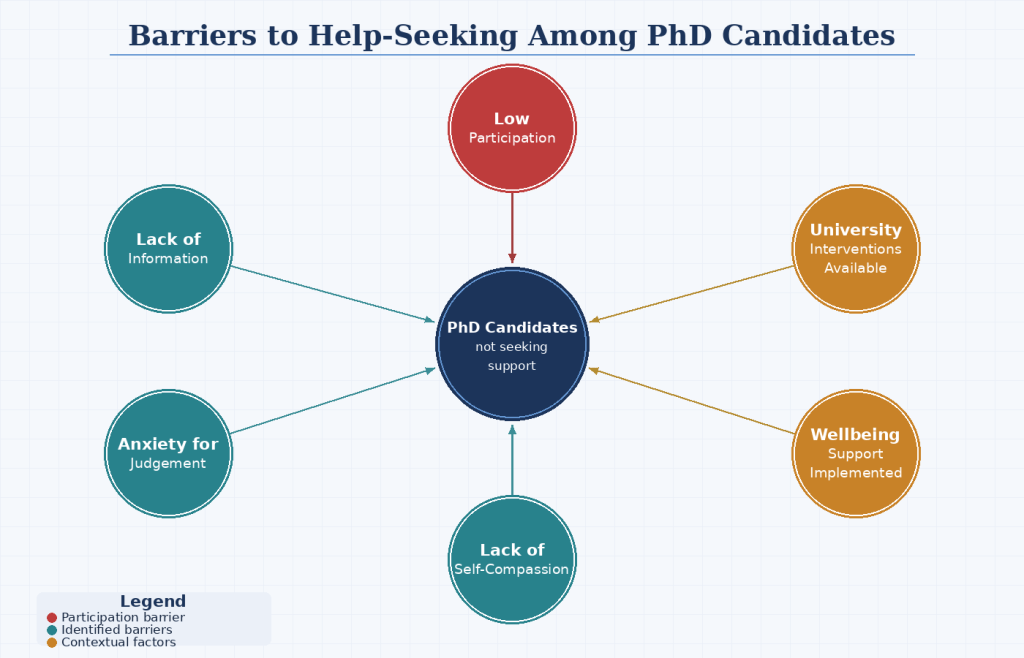
In the Vrije Universiteit Amsterdam, the PhD survey from 2023 showed that 26% of respondents reported that their PhD had a negative effect on their wellbeing, while 9% reported a very negative effect. Almost half of the respondents reported a delay in finalising their dissertation, which further increases the stress felt by these PhD candidates. Moreover, 44% of respondents did not feel supported or protected by the Vrije Universiteit Amsterdam after experiencing undesirable behaviour, further decreasing their motivation to address mental wellbeing through the institutional context.
Numerous articles have shown that PhD candidates are at an increased risk for developing psychiatric disorders, and the results of the PhD survey shows this risk is present at the VU as well. However, support systems at the VU are limited, and there’s a relatively high barrier of entry. Recent research indicates that experiences of mental health stigma and discrimination are still widespread within academic institutions (Berry et al., 2021), and it is unlikely the VU is unique in that regard. To the contrary, this stigma could indicate that the actual worries and discontent felt within the VU is higher than the survey suggests. Planning an appointment with the PhD psychologist, informing your supervisor of depressive symptoms or anxiety, or discussing these issues with potential co-workers could be perceived to risk a negative impact on a PhD candidate’s career, and as a result, mental health issues often go unspoken. Institutions such as Caring Universities (CU), a consortium of universities aiming to improve the mental wellbeing of students, have attempted to bridge this gap with online facilities, but with limited success.
We propose a low-intervention, low-threshold mental support system based on the Friendship Bench Program (Chibanda et al., 2015; Fernando et al., 2021). This intervention method is based on cognitive behavioural therapy, with an emphasis on problem-solving therapy. This therapy is given by trained lay people, who function as experts by experience. Expert by experience-based therapy has been shown to be effective in addiction therapy (Stull et al., 2022) and other forms of mental health support (Happell et al., 2022). The Friendship Bench methodology is unique in its use of trained lay health workers (LHWs) to deliver targeted mental health support in a low number of sessions (3 to 6).
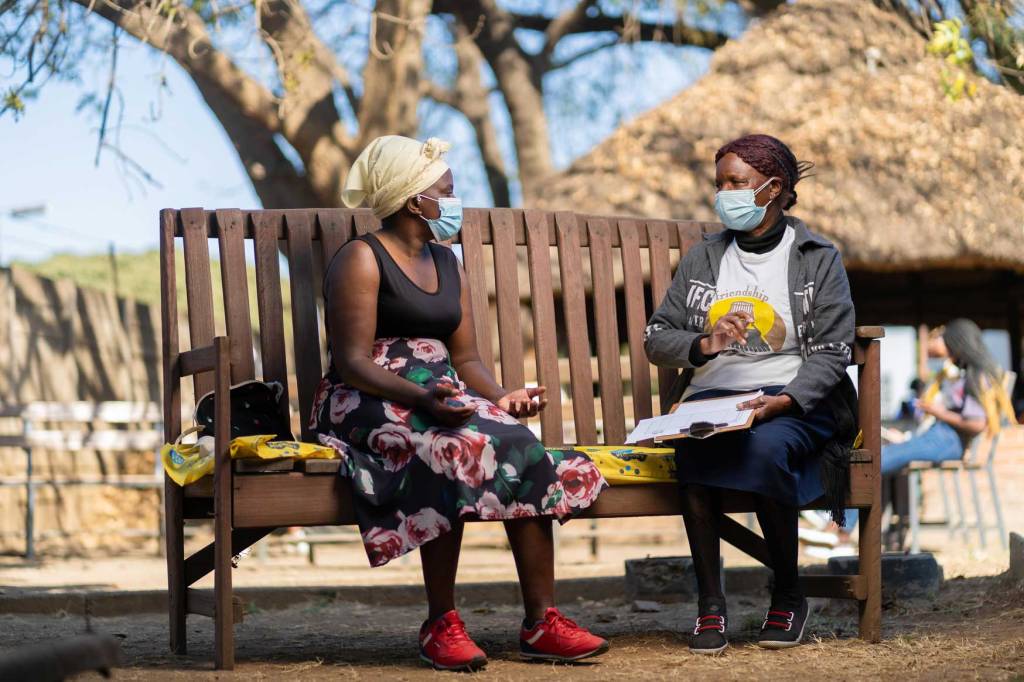
The proposed PhD Bench is inspired by the Friendship bench framework of CBT-based, accessible mental health services provided by LHWs. We have developed a single-session intervention strategy, where PhD candidates based at the Vrije Universiteit Amsterdam, including the Amsterdam Medical Center, can receive on-demand mental health support. Through the voluntary employment of emeritus professors as lay healthcare workers, PhD candidates can address issues they might not be able to otherwise. The emeritus professors’ function as experts-by-experience, which provides them with the implicit respect and knowledge, allowing for rapport to be bult between distressed PhD candidates and the functioning LHW. The PhD bench is an actual, physical space, based within the main building of the VU, where PhD candidates can come to discuss their mental distress on an on-demand basis, but online options are available for those not at the VU. The emeritus professors have been trained in basic coaching strategies, developed by the CU consortium. The emeritus professors will adopt a trio of functions:
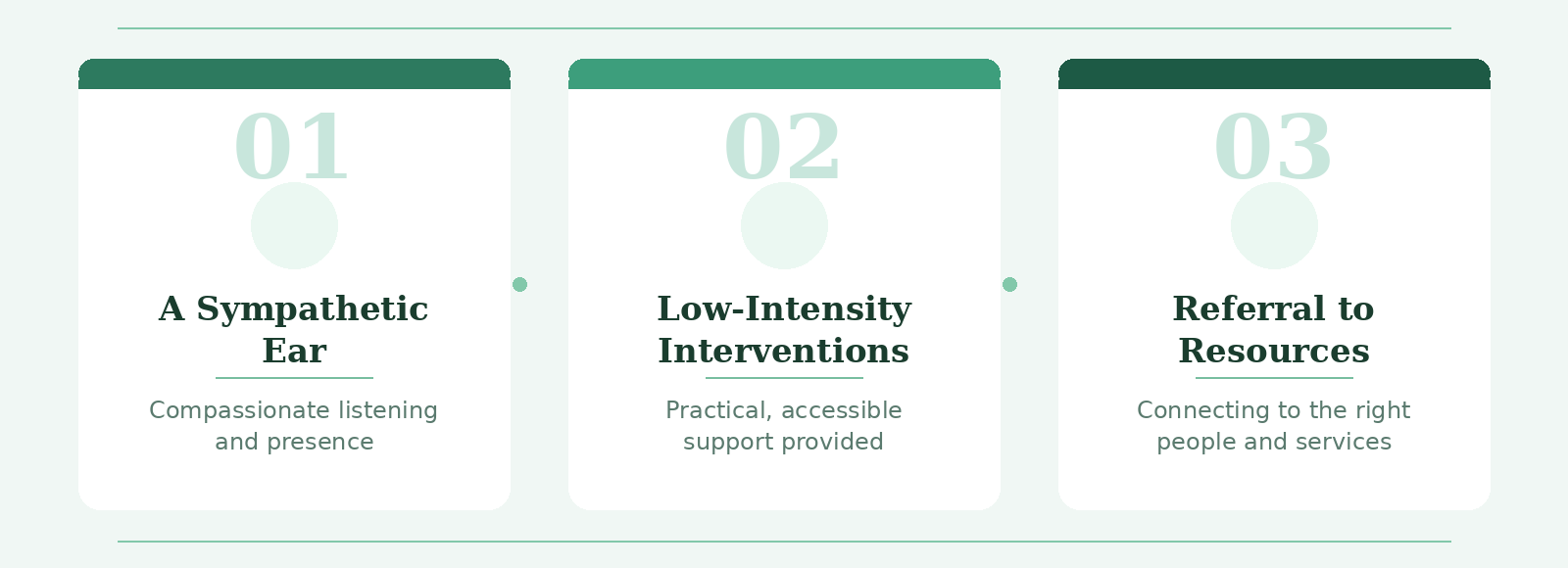
This concept will function in conjunction with existing mental health support. The accessibility of the program allows PhD candidates suffering from mental anguish to simply sign up and gain the desired assistance. Removing the additional step required to make an appointment with a therapist, discuss the situation with a supervisor or make an appointment with the general practitioner, a PhD candidate seeking support can sign up and find a sympathetic ear. However, this does not remove the need for more specialized, long-term support; following the single session, the LHWs will provide the PhD candidate with additional support they can acquire. The PhD bench serves as the initial point of contact. Those with more severe psychological anguish will be referred to either the PhD psychologist or the general practitioner.
The aim is that this will improve PhD candidates’ mental health in the short-term, by providing direct support on location, and long-term, by identifying PhD candidates who are at risk of developing psychiatric disorders and providing a clear network of support systems.
 PhD bench